House cleaning cost calculator
- What this clean costs you
- $206.42
- Computed on this page from the inputs below
- Paid hours in this clean, drive included
- 6.75
- Computed on this page from the inputs below
- Wages for the clean, before employer tax
- $128.25
- Computed on this page from the inputs below
- Labor once employer tax and insurance are on it
- $144.92
- Computed on this page from the inputs below
The constants in these sheets are the IRS employer payroll-tax rates: Topic 751 sets Social Security at 6.2% and Medicare at 1.45% on the employer side, and Topic 759 sets FUTA at 6.0% on the first $7,000 paid to each employee in the year, 0.6% once the maximum state credit applies. Where a sheet costs a trip, the figure is the IRS standard mileage rate. Every other number in the sheets is one you type in, because your wage, your supplies and your drive time are not ours to guess.
Email me this result
We will send you these figures and a link back to them. One email, nothing else unless you tick the box.
The figures above are one house worked as an example ($206.42). Put your own hours, wage and supplies in and the price moves as you type.
Download the House cleaning cost calculator worked example (CSV)
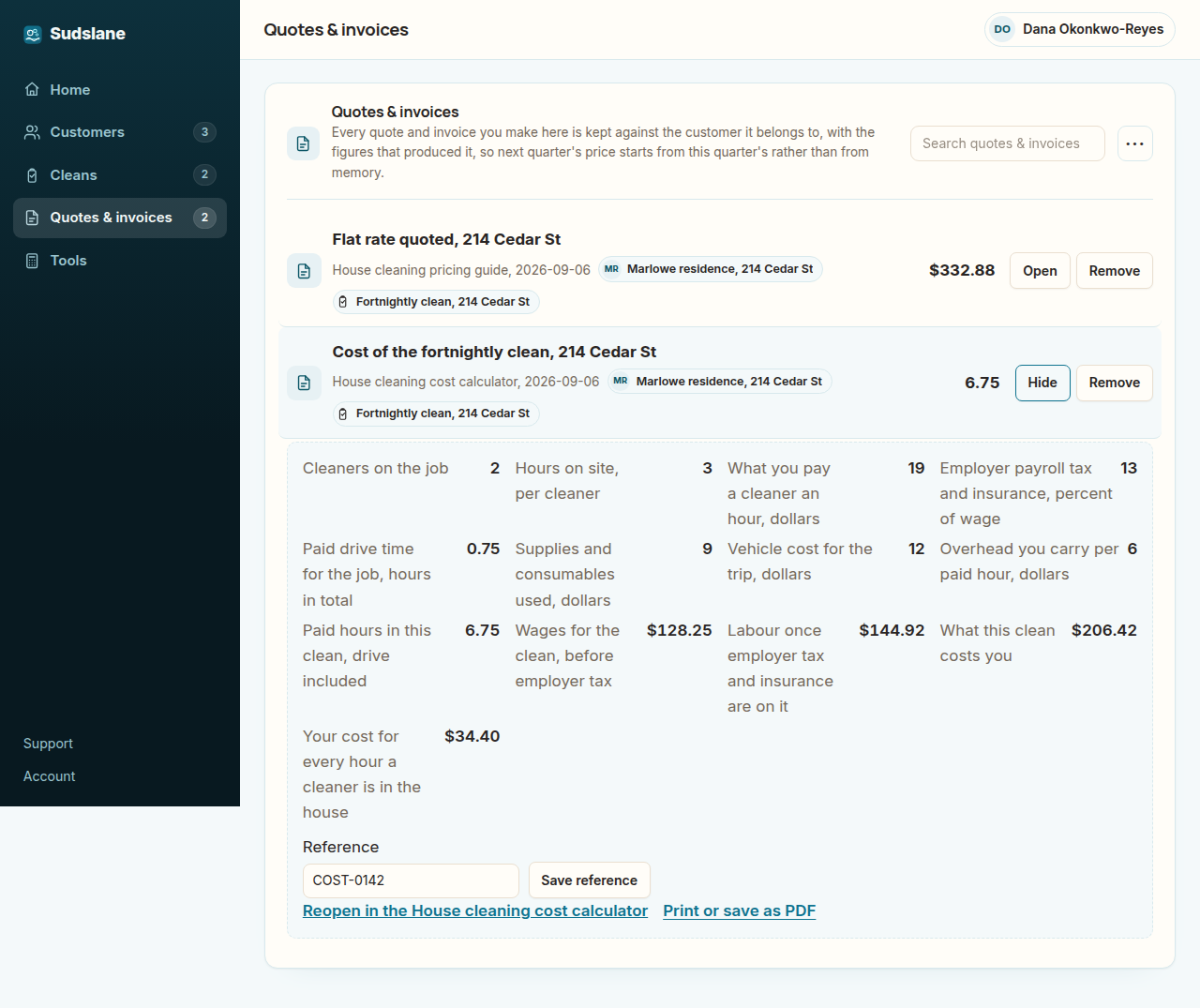
This sheet works out what one house clean costs your business, which is a different number from what you pay the cleaners. It takes the cleaners on the job and the hours each is on site, multiplies that out into paid hours, adds the drive time you actually pay for, puts the employer's share of payroll tax and insurance on top of the wage, and then adds the supplies used up, what the trip cost the van, and the overhead each paid hour has to carry. The answer is the floor under any price you quote for that house.
What owners ask before they price a clean with the House cleaning cost calculator
Why is the cost higher than the wage I pay?
Because the wage is not the cost. The IRS sets the employer's share of Social Security at 6.2% and Medicare at 1.45% (Topic 751), which is 7.65% before you add state unemployment, workers' compensation or any paid time off you fund. That is why the sheet asks for a burden percentage rather than assuming the wage is the whole story.
Should drive time be in here?
If you pay for it, yes. Time between houses that you pay a cleaner for is a cost of that house whether or not you bill the customer for it; leaving it out is how a tight route looks profitable and a spread-out one does not.
What do I put for overhead per paid hour?
Take the things that do not change with one clean, office, phone, software, marketing, your own unbilled time, add them up for a month, and divide by the hours you actually billed that month. If you bill 400 hours and carry $2,400 of overhead, that is $6 an hour.
Where the constants in this tool come from
IRS Topic 751: Social Security and Medicare withholding rates.
IRS Topic 759: Form 940, employer's annual federal unemployment (FUTA) tax return.